The aviation sector faces a profound challenge: reducing its environmental footprint while sustaining the performance, safety and economic viability that modern air travel demands. Reaching carbon neutrality by 2050 will require more than efficiency gains – it demands a step change in propulsion technology.
HyperMorpH is motivated by two converging opportunities:
Advanced fibre-reinforced polymer (FRP) composites are the key enabler: lighter, stronger and more adaptable than metals, they allow this propulsion concept to be both high-performing and structurally feasible.
01
To design and develop a cryogenic, ultra-light, high-power-density hyperconducting electric motor using sustainable thermoplastic FRP composites achieving step-change gains in efficiency, weight reduction and power density.
02
To design and manufacture self-morphing intake and rotor-tip-casing structures using thermoplastic FRPs, shape-memory solutions and metastructures – optimised for BLI performance across a range of flight conditions.
03
To develop an AI-supported digital toolkit combining Machine Learning, surrogate modelling, advanced data fusion and uncertainty quantification – enabling concurrent multidisciplinary optimisation of propulsion and aerostructures.
04
To validate the integrated hyperconducting motor and morphing aerostructures in a laboratory-scale aft-mounted BLI configuration, demonstrating the synergistic performance of the full propulsion–aerostructure system at TRL 4.
05
To assess the technical, economic, environmental and societal viability of the developed solutions, and deliver a technology roadmap supporting future exploitation and higher-TRL development beyond the project.
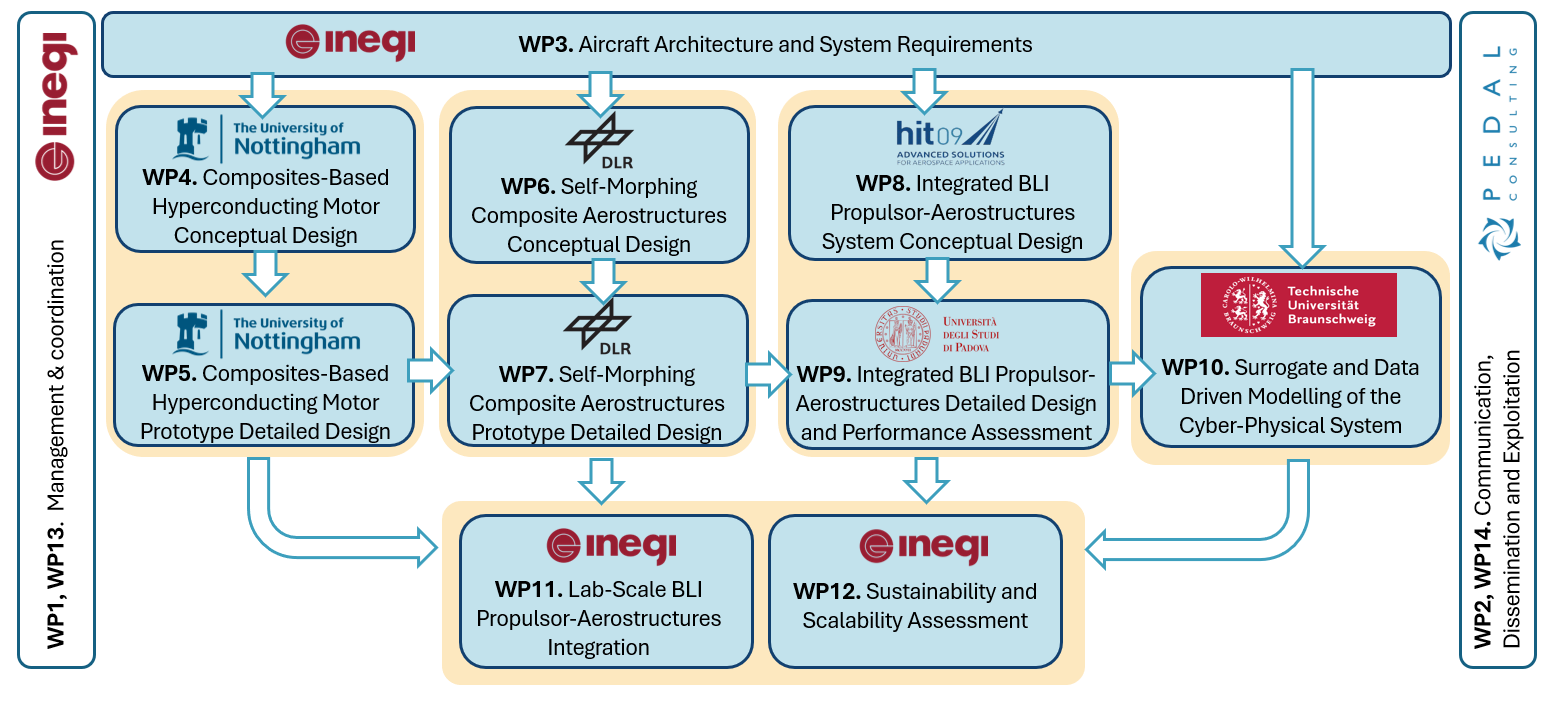
HyperMorpH follows a concurrent, multidisciplinary methodology that integrates materials development, digital simulation and experimental validation within a single coherent workflow. Work progresses in two phases: conceptual design and specification in the first 18 months, followed by detailed design, manufacturing, demonstration and validation through to project end.
The architecture of the project reflects its systemic ambition: rather than advancing individual components in isolation, HyperMorpH deliberately co-develops the motor, morphing aerostructures and digital tools in parallel, with shared interfaces and cross-WP feedback loops to ensure genuine integration.

Find out more about Expected outcomes
Funded by the European Union. Views and opinions expressed are however those of the author(s) only and do not necessarily reflect those of the European Union or the European Climate, Infrastructure and Environment Executive Agency (CINEA). Neither the European Union nor the granting authority can be held responsible for them. This project has received funding from the European Union’s Horizon Europe research and innovation programme under Grant Agreement No. 101192711.