
A new EU-funded project is rethinking how aircraft propulsion can work. From Porto to the sky, HyperMorpH has officially taken its first step on the road to zero-emission aviation.
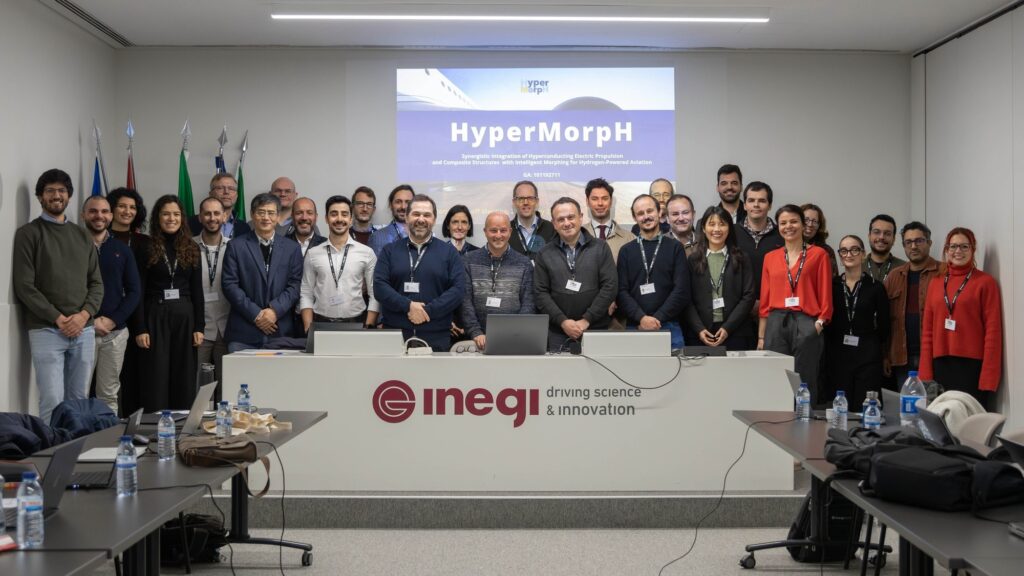
On 29 January 2026, the HyperMorpH consortium gathered in Porto, Portugal to officially launch the project. The meeting was hosted by the project coordinator, INEGI. With this kick-off, a new Horizon Europe Research and Innovation Action begins its 42-month journey. Its goal is to develop a new generation of hydrogen-powered, hybrid-electric aircraft propulsion systems. The initiative is backed by a total EU contribution of €4,999,397.66.
Aviation is essential to Europe’s mobility and economy, but it must drastically cut emissions to meet EU climate goals. Hydrogen-powered, hybrid-electric propulsion is widely seen as a key part of the answer. Yet its large-scale adoption demands new system-level designs, validation methods and integration approaches. HyperMorpH addresses that challenge head-on.
HyperMorpH is built around one insight: liquid hydrogen (LH₂) can do more than store clean energy. Its extreme cold can also make electric propulsion dramatically more efficient. Combine that cryogenic environment with advanced fibre-reinforced polymer (FRP) composites engineered for harsh thermal and electromagnetic conditions, and you unlock lighter, smarter, more integrated aircraft propulsion.
What we are developing is not just a single technology. It is a synergistic aircraft architecture, in which hydrogen, composites, intelligent structures and digital tools reinforce each other:
“To create world leading and disruptive zero-emission aviation, Europe needs solutions that work at system level, not just isolated technologies. HyperMorpH combines complementary expertise across Europe to move hydrogen-powered propulsion closer to real-world aircraft applications.” (Nuno Correia, Unit Director at INEGI and HyperMorpH Project Coordinator)
HyperMorpH brings together seven European partners spanning aerospace engineering, hydrogen technologies, composite materials, propulsion systems and digital engineering:
Together, the consortium will design and optimise hydrogen-powered hybrid-electric propulsion architectures. Partners will develop and validate lightweight composite electric motors and investigate hybrid concepts that remain robust during demanding flight phases. We will apply AI-supported digital tools to support system integration and reliability, and assess the performance, safety, and environmental impacts of future aircraft concepts.
Each partner brings distinct expertise and a strong track record of European research excellence.
Coordinator INEGI (Portugal) is a research and technology institute with 30+ years of aviation innovation, 38+ EU-funded projects and a €3.6M ERC Advanced Grant in aerospace composites. INEGI defines the project’s composite materials and manufacturing for cryogenic propulsion integration and leads consortium-wide requirements and system integration.
The University of Nottingham (UK), through its Composites Research Group and Power Electronics, Machines and Control (PEMC) group, develops and validates the project’s composite-based hyperconducting electric motor, building on 53+ projects including NEWBORN and HECATE.
The Università degli Studi di Padova (Italy) is one of Europe’s oldest universities, founded in 1222. With its spin-off HIT09 anchoring the aero-propulsive design, UNIPD studies the aeroelastic behaviour of the boundarylayer-ingestion (BLI) propulsor. HIT09 leads the BLI aero-propulsive system design and the project’s machine-learning-based digital models.
Technische Universität Braunschweig (Germany) belongs to the Germany’s oldest technical universities. It leads the digital side of HyperMorpH. Through its Professorship for Modeling of Complex Systems under Uncertainty and its Institute of Aircraft Design and Lightweight Structures, TUBS develops the project’s Digital Twin and intelligent design agents at the heart of the cyber-physical design framework.
The DLR Institute of Propulsion Technology (Germany) is the national research centre for aeronautical turbo machinery. The institute leads self-morphing composite aerostructures and the boundary-layer-ingestion propulsor optimisation, and hosts the project’s fan test bed validation.
PEDAL Consulting (Slovakia) is a proud national leading SME performer in Horizon 2020, Horizon Europe and COSME. It is in charge of communication, dissemination and exploitation tasks. The company builds the bridge between the consortium, stakeholders and the wider aviation ecosystem. Moreover, it shapes the Intellectual property and exploitation strategy that will turn results into uptake.
The initiative is funded by the European Union under grant agreement No. 101192711 and supported by Estanislao Parczewski Cruz, Project Officer at CINEA – the European Climate, Infrastructure and Environment Executive Agency.
With the kick-off complete, the consortium now begins its first wave of technical work. We are set to define the aircraft architecture and system requirements. Launching the conceptual design of the cryogenic hyperconducting motor and the self-morphing aerostructures, we are building out the foundations of the project’s Digital Twin.
From Porto to the sky – the journey starts now.
Read more info in the press release: PEDAL Consulting press release

Funded by the European Union. Views and opinions expressed are however those of the author(s) only and do not necessarily reflect those of the European Union or the European Climate, Infrastructure and Environment Executive Agency (CINEA). Neither the European Union nor the granting authority can be held responsible for them. This project has received funding from the European Union’s Horizon Europe research and innovation programme under Grant Agreement No. 101192711.